


What if words revealed the invisible mechanics of our problems?
- Jean-Dominique POUPEL

- Mar 5
- 11 min read

When language unveils the map
In our previous article, « The Reality We Live May Not Be the One We Believe, » we saw that we do not live in the world as it is, but in the map our nervous system constructs.
Beyond neurological, cultural, and personal filters, this map is shaped through three universal processes:
Deletion. Generalization. distortion.
What is less well known is that these same mechanisms show up in our sentences.
In other words:
Our language betrays the structure of our map of the world.
Each word we speak is a reduction. Each sentence is a condensed interpretation. And our words reveal more than we imagine.
A brief history of NLP: modeling excellence


Neuro-Linguistic Programming (NLP) was founded in the 1970s in the United States by John Grinder, a professor of linguistics, and Richard Bandler, a mathematician and psychotherapist.
Their ambition was singular: to understand why certain therapists achieved exceptional results… and how to reproduce that excellence. They therefore closely analyzed the behavioral, cognitive, and linguistic strategies of recognized master therapists such as Fritz Perls (founder of Gestalt therapy), Virginia Satir (a pioneer of family therapy), and Milton Erickson (father of Ericksonian Hypnosis), and extracted reproducible structures from them.
They called this modeling: identifying the patterns common to excellence in order to transmit them.
In 1973 they mapped language and created the meta-model. In 1975, at the University of Santa Cruz, their collaboration intensified and gave birth to NLP, whose trademark Richard Bandler would register in 1976. Sub-modalities appeared the same year, then meta-programs in 1979, and finally the timeline in 1987.
NLP would then evolve through three generations:
1st generation: focused on therapy and problem solving
2nd generation: extended to management, sport, and education
3rd generation, developed by Robert Dilts in 2006, integrating a systemic and collective dimension
Let’s focus on one of the very first tools, and arguably the most structuring: the meta-model.
The Meta-Model: a tool of precision… and responsibility

The meta-model is a mapping of language.
It identifies 12 classic forms of linguistic reduction, grouped into three categories:
Deletion.Generalization.Distortion.
These mechanisms are necessary to survive in a complex world. But when they become rigid, they produce symptoms. And this is where the philosophical dimension appears:
Because if my words reflect my map… And if my map can be questioned…
Then I’m not condemned by my interpretations.
The map is not arbitrary. It is structured.
And what is structured can be restructured.
The meta-model thus becomes an existential act:
It doesn’t correct the world.
It questions the way I construct it, and the way I interact with it.
DELETION: what is not said, and what disappears

Deletion is an economy of awareness.
But it can also conceal responsibility.
It is also when parts are missing from the sentence.
For example: “I’m useless”, “No one loves me” , “I’m not okay”, “It’s pointless”…
To this we can ask: “Useless at what?”, “Exactly who doesn’t love me?”, “Not okay how?”, “Pointless for what?, for whom ?”…
And suddenly, the sentence changes.
Another example, with a symptomatic sentence: “I’m depressed”
Left as it is, the sentence sticks to identity. But if we ask: “Since when?”, “In which specific situations?”, “What do I do when I’m ‘depressed?”, then we often discover something entirely different, almost like reaching the roots of the “depressed” flower:
“I feel empty in the evening”, “I feel devalued”, “I isolate myself”, “I repress my anger and turn it into apathy”…
That is when we move from a fixed identity to a specific experience.
1. Simple deletion
This is the most common deletion: details about the object of the verb are missing.
« I’m not okay. » (How?)
« I feel empty. » (Of what?)
« I’m depressed. » (In which situations?)
Precision transforms a global identity into a situated experience.
2. Missing referential index
This deletion is at least as frequent as simple deletion: we never know who or what we are talking about. These sentences often begin with “They,” “It, “, “This”, “That”, “Others”…
“People judge me” (When? Who specifically?)
“They don’t listen to me” (Who are “they”? In what circumstances?)
“They don’t understand anything” (Who are “they”? When I explain what?)
Anonymity sustains powerlessness.
Naming is reintroducing something concrete.
3. Incomplete Comparison
These are sentences with a comparative : “better than,” “more than,” “less than,” “worse than”, but without the comparison target: the second part of the comparison is always missing.
“I’m not good enough” (Compared to whom? To what?)
“It was better before” (Before when? Better how?)
“I’m worse than them” (Worse in what way? And in what way am I better?)
This deletion hides low self-esteem or a prejudice.
The implicit comparison installs an invisible hierarchy.
4. Unspecified verb
This type of deletion creates doubt about the meaning of the sentence: the verb used can be interpreted in several ways.
“He hurt me” (How? Physically? Emotionally?)
“I’m stuck” (Stuck on what? How?)
“I was betrayed” (By whom? Betrayed in what way?)
Vagueness maintains indistinct pain.
Deletion sustains pathology.
Precision opens movement.
GENERALIZATION : when experience becomes a rule, or even a law

Generalization is very useful: it is a learning shortcut. Without it, we would have to relearn every day that fire burns. But it becomes confining when it turns into destiny, and it can become rigid.
For example: “I always fail,” “I’m never good enough,” “Others are dangerous,” “No one understands me,” “I have to be perfect.”
To this we can ask: “Always, really?”, “Never… never?”, “Not even once?”, “No one… no one?”…
Generalization turns a one-time pain into a universal law.
Another example, with an anxious sentence: “I’m going to fail for sure.”
“For sure?”, “What guarantees it?”, “What has already happened differently?”…
5. Universal quantifiers
This is the kind of generalization that nearly everyone makes almost all the time: sentences that contain the words “all,” “always,” “never,” “nothing,” “no one,” “people,” “everyone”… or imply them.
“I always fail.” (Always? Isn’t there a time I succeeded?)
“No one loves me.” (Really no one? Not even my dog?)
“It never works.” (Has it truly never worked? Never?)
To counter this generalization, it is important either to exaggerate the generalization (to show its absurdity), or to find a counterexample. Thus, for “It never works,” we can ask “It has truly never worked? Never?” (exaggeration) or “Can I remember a time when it did work?” (counterexample).
One exception is enough to crack fatalism.
6. Modal operators of “necessity”
Modal operators of “necessity” give the impression that choice does not exist, which is often false: they refer to an “external force” that supposedly pushes one to act this way: “I must,” “I’m obliged to,” “I have to,” “it is necessary,” “it’s mandatory.”
“I must be perfect.” (What would happen if I weren’t? Who would that bother?)“I have to succeed.” (What would happen if I failed? Who would be disappointed?)“I’m obliged to act like this.” (And if I acted differently? What would happen?)
Behind modal operators of “necessity,” there is often an invisible loyalty.
6.1 Modal operators of “impossibility”
Modal operators of “impossibility” are also considered as modal operators of “negative possibility” : they highlight powerlessness rather than external pressure: “It’s impossible,” “It’s not possible,” “I can’t,” “I’m not able to…”
“I can’t.” (What prevents me?)
“It’s impossible.” (And if I could do it, what would happen?)
“I can’t tell them that.” (What would happen if I did? What am I risking?)
Questioning modal operators often reveals the real obstacle that prevents acting as desired. These are imposed beliefs that shape part of identity.
Let’s create a distance in order to understand what lies behind modal operators
7. Nominalization
This is the form of generalization most often used to put a problem at a distance from oneself, by remaining passive in the situation: a verb is turned into a noun or an intangible concept…
“I lack confidence.” (Confidence how? In whom? In what?)
“Communication is broken.” (Who is unable to communicate? What is not being communicated?)
“There is a problem.” (What problem exactly? With whom?)
To tell the difference between a nominalization and the ordinary use of a noun, simply imagine the situation unfolding in a room. If you can’t, it’s a nominalization.
Nominalization freezes a living process into an immobile thing.
8. Lost origin
Lost origins are beliefs: they give the impression of being self-evident: rules, judgments, proverbs, without knowing who said it or when the idea came from.
“You don’t do that.” (According to whom?)
“That’s wrong.” (Who says so?)
“You have to suffer to succeed.” (Really? I can’t succeed without suffering?)
“I’m a wreck” (Where does this idea come from? Who has ever told that to me?)
The lost origin turns a belief into a universal truth.
Generalization creates fatalism.
The meta-model reintroduces possibility.
DISTORTION: when meaning is added
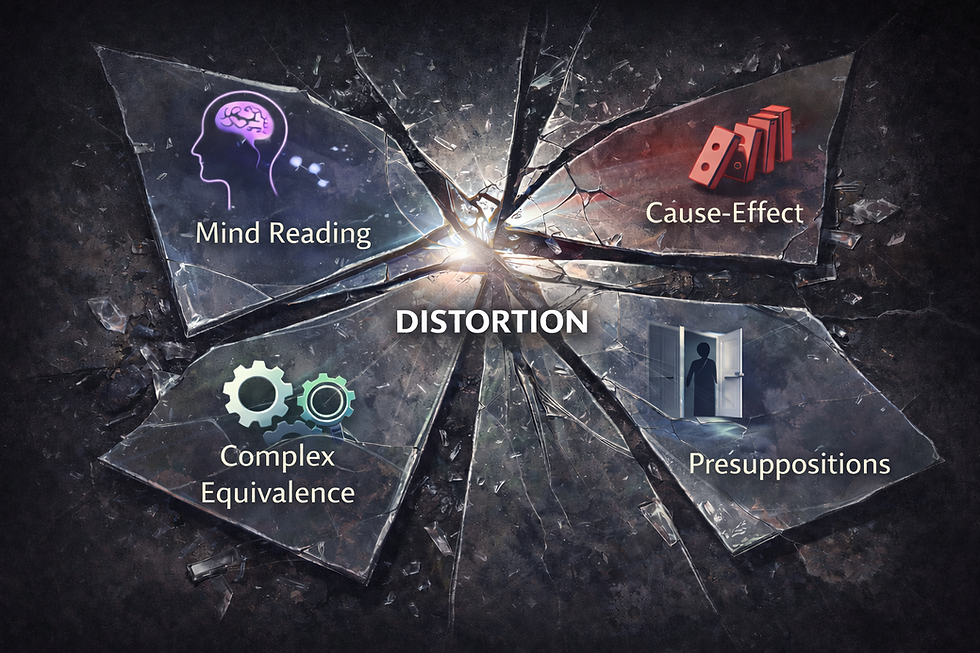
Distortion links two elements without sufficient proof.
It is the mechanism of anxiety… and of creativity.
In distortions, the brain manufactures a link.
For example:
“He didn’t reply, he’s mad at me.”: Silence = rejection
“If I make a mistake, they’ll reject me.”: Mistake = humiliation
“My boss is putting pressure on me, he wants me gone.”: Pressure = attack
“If I don’t control everything, everything will collapse.”: Control = safety
To this we can ask: “How do I know?”, “Is it written somewhere?”, “Have I asked?”…
In anxiety, distortion becomes “catastrophism”:
“I have a knot in my stomach, that means it’s going to go badly.”: Sensation = prediction.
Distortions are errors of logic, voluntary or not, often used to avoid responsibility for an unpleasant situation. They are quite difficult to spot, because the sentences they produce seem to make sense. According to Chomsky, we often take shortcuts in our reasoning by making assumptions, which at the same time moves us away from the truth.
9. Mind reading
This distortion is wrongly attributing to others a feeling or a state of mind, assigning an intention to a behavior or to the absence of a behavior, sometimes even insignificant ones like a raised eyebrow or an averted gaze: in short, it is thinking you are inside the other person’s head.
“He thinks I’m useless.” (How do I know? Did he tell me?)
“I know she despises me.” (How did I come to that conclusion?)
“You’ll see, you’re going to love it.” (What am I basing that on?)
Mind reading removes uncertainty.
Once questioned, it often turns into complex equivalence or cause-effect.
10. Cause–effect
This distortion is very interesting, as it creates a kind of disempowerment of reactions, emotions, and thoughts towards a person or situation by creating a link between a cause and an effect that have nothing to do with each other: they take the form of “X causes Y” or “X leads to Y.”
For example, “He makes me anxious.”
(Here, “he” would have the power to create anxiety, which is impossible. It is indeed “me” who produces anxiety. Although we can say that “he” adopts a behavior that “makes me anxious,” in the end I am responsible for my anxiety. It is “me” who decides to be anxious, in reaction to “him.” (Of course, an external behavior may trigger a reaction, but the internal state remains a Neuro-emotional construction belonging to the subject.)
“My boss stresses me out.”
“My children exhaust me.”
By questioning the link between cause and effect, the logical error becomes clear.
By asking ourselves how X caused Y, we can break this link and take back responsibility for our reactions, emotions, and thoughts.
11. Complex equivalence
Complex equivalence, on the other hand, transforms an event into a definition of oneself. Two completely different statements are linked in a sentence, as if they meant the same thing: the sentence is constructed in the form “X proves Y” or “X = Y.”
“He didn’t call me, he doesn’t love me.” (How does the fact that he didn’t call prove that he hates me?)
“I’m wrong, therefore I’m incompetent.” (Is there anyone who never makes mistakes?)“I’m anxious, therefore I’m weak.” (What is the logical link between these two statements?)
Complex equivalence turns an event into a definition of self.
It is important always to ask what the links are between two statements or two thoughts
That makes it possible to change the perception of an event.
12. Presuppositions
Presuppositions are the most commonly used distortions, present in almost every sentence: it allows others to understand the context without having to specify it. The problem is that some presuppositions can be limiting or manipulative.
Example of an innocuous presupposition:
“When this morning’s customer comes back, I’ll show him my best items.”
From this sentence, a number of pieces of information can be inferred:
There is a customer who came (“the customer”)
The customer came this morning (“this morning’s”)
The customer said he would come back (“comes back”)
I did not show him the store’s best items (“I’ll show him my best items”)
The customer is going to come back (“when the customer comes back”)
But some presuppositions can be more problematic:
“If my husband knew how terrified I am when he shouts, he wouldn’t behave like that.”
She is married.
She doesn’t talk to him.
Her husband doesn’t know about her reaction to his shouting (mind reading).His shouting terrifies her (cause–effect).
The presupposition here combines two distortions: mind reading and cause–effect. This leads to a serious logical error. Not only would the husband have the power to terrify his wife, but he would do so unconsciously.
Other presuppositions are more subtle and manipulative, especially illusory choices that lead to the same result.
For example:
“Are you paying in cash or by card?” (Presupposition = you are paying either way.)
“It’s a bit cold, isn’t it?” (Presupposition = Can you turn up the heat? Close the window? Bring me a sweater or a scarf? …)
Beyond technique: a question of freedom
The meta-model is not just a linguistic tool. It asks a fundamental question:
Am I ready to examine the structure of my own interpretations?
When I say, “I’m like that,” the simplest question would be: “I’m like that… exactly how?”
And in that moment, identity stops being a fate.
NLP and Humanist Hypnosis: two levels of transformation
NLP sheds light on the structure of the map. It identifies where it has become rigid.Humanist Hypnosis explores the symbolic space in which that map is drawn.
NLP works on formulation.
Humanist Hypnosis works on representation.
One opens the door.
The other steps through the threshold.
Conclusion: the first crack in the automatic pattern

Freedom does not begin by changing the world.
It begins when we realize: what I live is a construction.
And if a construction can be observed… it can evolve.
The meta-model is not a debate technique.
It is an invitation to reclaim responsibility for our interpretations.
And perhaps our aches are not only events…
But words left unquestioned.


Comments