


What Our Rituals Say About Us - Episode 1
- Jean-Dominique POUPEL

- 1 day ago
- 6 min read
Humanity Was Built on Gestures

A very long time ago, before we even had precise words to explain death, birth, fear, love or the passing of time, we did something strange.
We made gestures.
We lit fires.We buried our dead.We painted walls.We sang around bodies, seasons, absences.
We traced circles, raised stones, repeated words, prepared meals, marked bodies, separated spaces, chose moments.
Before understanding, we staged.
Before explaining the world, we ritualised it.
And this is perhaps one of the most profound things one can say about humanity: we are not only beings who think, who make, who speak, who survive.
We are beings who give a form to what overwhelms us.
For there have always been, in human experience, moments too great to remain raw.
Birth, too immense to be only biological.
Death, too violent to be only the stopping of a body.
Love, too charged to be only an emotion.
The passing of time, too dizzying to be only a succession of days.
Fear, too ancient to be only a nervous signal.
So we invented forms.
Not only tools to cut, hunt, build or defend ourselves.
Tools to signify.
Gestures that did not serve only to act on matter, but to organise the invisible.
It is in this sense that ritual is perhaps one of the oldest human technologies.
Not a technology of stone, metal or silicon.
A technology of meaning.
A way of putting rhythm where there is chaos, symbol where there is the formless, the shared where there is solitude.
And perhaps that, without those gestures…
…we would not only have lacked religion, tradition or culture.
We would have lacked inner form.
What makes a gesture become a ritual
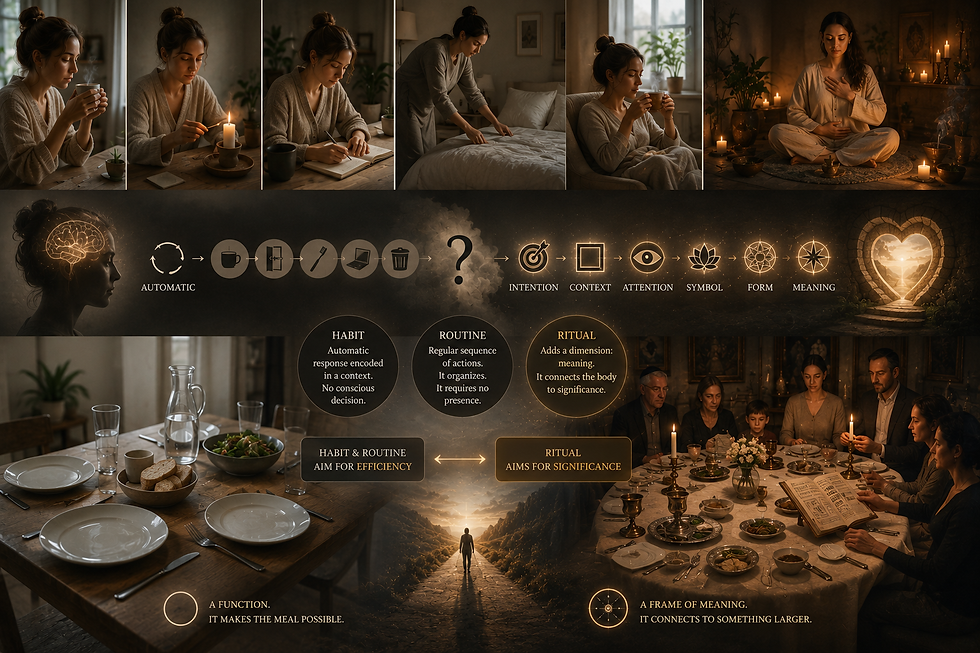
Today, the word ritual is used everywhere and for everything. We speak of a morning ritual, a beauty ritual, a productivity ritual, a sports ritual, a love ritual, a full-moon ritual, a gratitude ritual, a sleep ritual.
The word has become fashionable.
And like most words that become fashionable, it has weakened.
It ends up sometimes designating any habit repeated with a little aesthetic around it.
Making one’s coffee.Lighting a candle.Writing three lines in a notebook.Making one’s bed.Drinking an herbal tea in the evening.
But repeating a gesture is not enough to make a ritual.
Otherwise, brushing one’s teeth would be an initiation rite, opening one’s computer each morning would be a ceremony, and taking out the bins would become a spiritual practice.
So, something is missing.
Repetition is not enough; something else is needed.
An intention. A frame. A particular attention. A symbol. A form. A meaning. A way of doing that says: this is not only a useful gesture, this represents something.
That is where the essential difference lies.
Besides, habit, routine, ritual are three words that do not tell the same story, yet are often confused.
They deserve to be untangled, because they do not speak of the same thing within us.
Habit is an automatism. The psychologist Wendy Wood, who has devoted her work to it, describes it as a response encoded in a context: same situation, same gesture, without conscious decision. Habit is precious — it frees up attention. But it works precisely because we no longer think about it.
Routine is a regular sequence of actions, sometimes chosen, sometimes endured. It organises. It requires neither presence nor meaning.
Ritual, for its part, adds a dimension: meaning.
One could put it this way:
Habit and routine aim at efficiency.
Ritual aims at meaning.
Setting the table, for instance, is not necessarily a ritual. Most of the time, it is a practical arrangement. We lay out the plates, the cutlery, the glasses. The gesture has a clear function: to make the meal possible.
But that same gesture, in a Seder of Pesach (the Jewish Passover), changes in nature.
The table is no longer only a table.The food is no longer only food.The meal is no longer only a meal.
Each element carries a memory, each order has a symbolic function, each word links those who are present to a story vaster than themselves.
The outer gesture may be almost the same, but not the inner world in which it unfolds.
And that is precisely what makes the ritual: the form matters as much as the result. Sometimes more. Why say that particular phrase, at that particular moment? Why take three steps and not two? Why light that lamp before speaking? Seen from the outside, these details may seem useless. And that is exactly what makes them ritual: they tell the body that this moment is not ordinary.
The psychologist Nicholas Hobson and his colleagues, in their major synthesis of 2017, describe ritual as a predefined, repeated sequence of actions, set within a framework of symbols — and part of which has no direct practical use.
And perhaps that is what a ritual is: a gesture that opens a depth.
Not because it would be magical.
But because it brings the body into a meaning.
Acts beyond words

There are moments when speaking is not enough.
One can explain a separation for hours, and still feel that something is not finished.
One can understand intellectually that a person has died, and inwardly keep waiting for their return.
One can know that a stage is over, that a place is no longer ours, that a relationship belongs to the past, that a version of ourselves no longer really exists.
And yet, something remains open.
As if thought had understood, but not the rest of the being.
That is perhaps where ritual appears.
When the event is too great to remain an idea.When emotion overflows language.When the passage calls for a form.
Ritual does not replace words. It extends them differently.
It takes what is invisible — a loss, a promise, a belonging, a rupture, a gratitude, a fear, a hope — and gives it a body.
Lighting a candle does not bring back the dead, but that gesture can give absence a place.
Closing a door is not enough to heal a story, but it can help to acknowledge that a threshold has been crossed.
Sharing a meal does not automatically repair a community, but it can remind us that a group still exists.
Standing together, singing together, walking together, being silent together: none of this perhaps changes the facts, but it changes the way the facts are inhabited.
And often, that is precisely where change begins.
Not in the event itself.
But in the form we give it.
Ritual as the architecture of the group

A human being alone can have habits, routines. But a group needs rituals.
It is not enough for individuals to be gathered in the same space to form a community. Something is needed to link them. Something that makes them feel, beyond personal interests, that they take part in a common reality.
When a group sings together, prays together, celebrates together, weeps together, applauds together, gathers in silence together, it does not merely carry out an outer sequence. It produces a collective experience.
Émile Durkheim, the French sociologist (1858-1917), spoke of collective effervescence. For him, rituals are not only religious or traditional gestures. They are moments when the group recognises itself, reactivates itself, feels that it exists.
That strange moment when individual emotions seem to amplify one another, until they produce the feeling of belonging to something greater than oneself.
We can see it in religious ceremonies.
But also in stadiums, concerts, demonstrations, commemorations, minutes of silence, shared songs, popular festivals.
A whole stadium holding its breath.A crowd singing the same refrain.Strangers who do not know one another, but who weep together before the same symbol.A country that stops for a few moments to honour its dead.
In those moments, ritual does not only hold a belief together.
It holds a group together.
It transforms an individual emotion into a shared experience.
And this is perhaps one of its oldest functions.
To keep the human being from remaining alone before what overwhelms them.
And what have we done with this inheritance?

We know how to plan meetings, fill in forms, send messages, archive memories, automate tasks, measure results.
But do we still know how to mark the passages? To close a stage other than by moving on to the next? To say farewell other than by disappearing? To begin something other than by putting it in a calendar?
We have not lost all our rituals. But many have been sped up, emptied, replaced by procedures, or abandoned at the surface of things.
And when a society no longer knows how to ritualise its passages, something comes undone. We find ourselves alone.
Alone before grief.Alone before separations.Alone before changes of identity.Alone before invisible endings.Alone before the beginnings that were never truly named or welcomed.
For if humanity was built on gestures, it was not out of naivety.
It is perhaps because it knew that the most dangerous moments are not always the dramas themselves.
But the thresholds.
Those strange zones where the old world is no longer there, and where the new has not yet taken form.
And since the beginning of time, we have needed rites.
To cross through.
Not to remain stuck between two worlds.
And not to leave a part of ourselves at the edge of the passage.


Comments