


Who are you when the mask comes off ?
- Jean-Dominique POUPEL

- May 13
- 6 min read
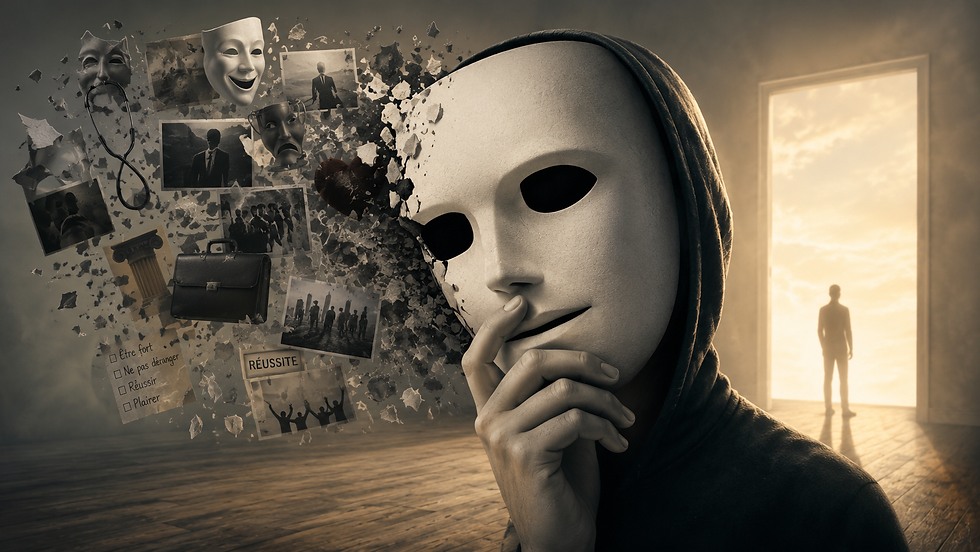
When was the last time someone asked you the following question — not what you do, not what you like, not your hobbies...
But rather: who are you behind your name, your image, behind your work, your status, behind all that identity around which you have built your life?
"Who am I?"
This is the question most people cannot answer…
But the moment you begin to ask it…
That's when everything begins…
The silence after the role

There is always a strange moment that comes over us without warning — one that almost everyone has experienced.
A quiet moment. Almost invisible. The one where everything stops.
No more work.
No more notifications.
No one left to impress.
No role left to play.
The phone finally stops buzzing.
The noise dies down.
The day comes to an end…
And for a few seconds… an unusual silence.
As if, behind all the automatic gestures, behind the habits, the conversations, the responsibilities and the distractions… a question had been waiting for a long time.
A simple question.
But strangely difficult:
"Who am I… when I'm no longer being someone for someone?"
And often, at that precise moment, something becomes uncomfortable.
Because we realize how much of our life consists of responding to expectations.
Of functioning.
Of playing a role.
Of maintaining a coherent image.
As if we spent our entire existence becoming someone…
…without ever really stopping to look at who is living through all of it.
We almost never truly answer the question
"Who am I?"

When someone asks who we are, we rarely answer the question.
We answer instead what we do, what we feel, what we have lived through, or the way we have learned to survive.
"I'm a therapist."
"I'm a father."
"I'm someone who's anxious."
"I'm highly sensitive."
"I'm independent."
"I'm a strong person."
"I'm someone who was abandoned."
"I'm someone who always has to manage everything."
But does any of this really describe an identity?
Or only roles, states, adaptations, strategies that have become familiar?
Because over time, many things end up getting confused with what we call "us."
A job becomes a definition.
A wound becomes a personality.
A habit becomes a character.
A protection becomes an identity.
And the problem is that what allowed us to hold on at a certain point in time… is not necessarily who we are at our core.
Some people learned very early that they had to be strong to be loved.
Others that they had to be quiet to avoid conflict.
Others still that they had to succeed to have value.
So they adapted.
And sometimes, the adaptation worked for so long… that they ended up believing it was their nature.
But having become someone in order to survive…
…does not necessarily mean that's who one is…
A "self" far less stable than we think

We have the impression of being "the same person."
And yet, if you look honestly at your life… you will see that almost everything has changed.
Your tastes.
Your beliefs.
Your priorities.
Your relationships.
The way you love.
The way you think.
Even your body is no longer exactly the same.
And more troubling still, your memories themselves change over time.
Human memory is not a faithful recording.
It reconstructs. It selects. It reinterprets.
In other words, a part of what you call "you" is already a reorganized story.
So what gives this strange impression of continuity?
Perhaps this very inner story that we tell ourselves constantly.
The philosopher Paul Ricœur proposed the idea of a narrative identity: what gives the sense of continuity is not that everything remains identical, but the capacity to connect events into a coherent story.
We tell our life like a story.
And that story gradually becomes:
Our identity,
Our logic,
Our way of understanding the past,
And even our way of anticipating the future.
The problem is that a narrative can also become a prison.
Because after repeating to ourselves…
"I'm the one who fails."
"I'm the one who has to carry others."
"I'm someone people always end up leaving."
…we are no longer simply describing our experience.
We begin to organize our reality around it.
And that's where something becomes fascinating.
Perhaps we are not only made of memories…
but also of the interpretations we have built around them.
The social character

There is another layer that is even harder to see and to admit.
The social character.
Carl Jung spoke of the persona — the psychological mask we develop to function in the world.
And sociologist Erving Goffman described social life as a stage on which each person learns to present a certain version of themselves.
At the end of the day, we all do this.
We adjust our language, our attitude, our face, our energy.
Not necessarily to manipulate. Often simply to belong.
We become:
The competent professional,
The solid parent,
The funny friend,
The calm person,
The one who manages,
The one who reassures,
The one who doesn't make waves,
The one who succeeds…
And the more we play certain roles… something fateful can occur:
We no longer know exactly where the role ends.
And many people can no longer tell the difference between who they are… and who they have had to become in order to function in the eyes of others.
So they continue.
They smile when they are exhausted.
They perform when they are lost.
They project a coherent image when everything inside is becoming blurred.
And sometimes, the most painful thing is not wearing the mask.
It is having forgotten there was one.
The contemporary trap: turning your identity into a showcase

The problem is not new, but our era has amplified it to an unprecedented level. Before, roles were local and limited to certain contexts.
Today, they are permanent.
It is largely social media that has turned identity into continuous exposure.
It is no longer enough to exist — you have to be visible.
Visible.
Readable.
Identifiable.
Consistent.
Shareable.
So each person gradually constructs a version of themselves.
A presentable version.
An understandable version.
An optimized version.
The problem is that after constantly broadcasting an image… one can end up living more in one's representation than in one's actual experience.
We become:
An aesthetic,
A positioning,
A trauma-identity,
A performance-identity,
A brand-identity.
Even suffering sometimes ends up becoming an identity language.
"I'm anxious."
"I have ADHD."
"I'm highly sensitive."
"I'm broken."
"I'm in recovery."
These words can bring relief. They can help us understand ourselves — but sometimes, they also become invisible prisons.
Because a diagnosis, a wound, or a difficulty can explain part of an experience… without summing up the totality of a person.
And the more time we spend observing ourselves through an external gaze…
...the more another capacity diminishes: the ability to simply be present to ourselves.
As if we had become visible… before ever having been truly inhabited.
So… who is left?
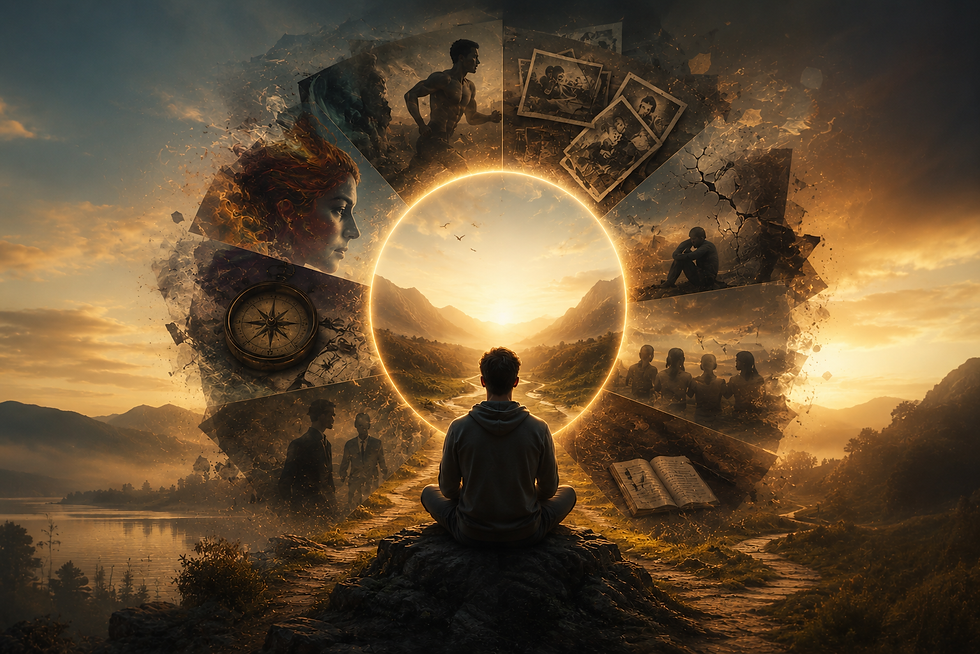
And this is where many people search for an absolute answer.
The "true self". The pure identity. The hidden core.
But perhaps everything begins precisely there.
Because neither philosophy, nor psychology, nor neuroscience seems to genuinely support the existence of a "self" that is simple, fixed, and entirely unchanging.
And yet… the opposite idea — that of a total absence of identity — seems equally unlivable.
We need a certain continuity to love, to choose, to promise, to build, to remember.
So perhaps identity is neither a fixed essence… nor a total illusion. Perhaps it looks more like a living architecture.
A body.
A memory.
Emotions.
Values.
Wounds.
Relationships.
Roles.
Narratives.
A way of inhabiting the world.
And in the midst of all this… a consciousness capable of observing what is happening… without reducing itself entirely to what it is going through.
Perhaps growing up does not mean "finding your true self."
But becoming conscious enough to no longer completely confuse yourself:
With your thoughts,
With your wounds,
With your roles,
With your performances,
With your fears,
Or even with the story you tell about yourself.
Because deep down… you are probably not a fixed thing to be discovered once and for all.
You are something far more alive than that.
So perhaps the real question is not:
"Who am I ?"
But:
"What remains of me… when I stop, for a moment, trying to be someone?"


Comments