


Why am I always on my guard? - Episode 1

Where it all begins

There are sounds that some children know better than their own name. Sounds tied to a time of learning, and deeply embedded…
The sound of the key turning in the lock, for instance…
Not only the sound, but everything that goes with it: the manner, how long the key takes to turn, whether the door closes softly or all at once, the number of steps in the hallway, the weight of those steps, perhaps even the way a bag has just been set down somewhere…
And before anyone has even entered the room, the child already knows what kind of evening is beginning.
They have seen nothing. No one has spoken. Nothing has happened yet.
But something in them is already alert, and beginning to take up position.
In a few moments, the adult will appear, and the child will know immediately.
They will know whether they can carry on playing, whether it would be better to keep a low profile, whether they can talk about their day, whether they should wait, whether they should make people laugh, or keep out of the way…
They probably could not explain how they know.
They have never drawn up a list of the cues they use.
They have never decided:
« From now on, I am going to watch for the signs that show what mood the adults are in. »
And yet, they have learned.
What we learn without needing to put it into words

As we saw, in the previous series (Why do others affect us so much?), some children become extremely fine readers of certain emotional signals.
An expression, a change of tone, a look, a tension in a face…
We also saw that this fineness of perception is not always a gift received at birth. It can be a skill that was developed, because one needed to know, because knowing made it possible to anticipate, and anticipating made it possible to be protected.
And this fineness of perception is not necessarily a sign of fragility either.
In certain environments, it can amount to a genuine protective skill.
In 2002, the psychologists Seth Pollak and Pawan Sinha compared how physically maltreated children and control children recognised different facial expressions. The researchers gradually revealed the information needed to identify the emotion.
Children who had suffered physical violence could recognise anger with less perceptual information than children in the control group. In other words, they were not simply « more emotional », but their perception seemed to have specialised for a signal that was particularly relevant in their environment.
A few years later, Pollak, Messner, Kistler and Cohn found the same idea in another form: children exposed to high levels of parental anger and physical threat identified anger earlier in the gradual unfolding of a facial expression. The speed of recognition was also associated with the level of anger and hostility reported in their family environment.
What a child encounters regularly therefore seems able to play a part in shaping what they learn to detect quickly.
Of course, this work concerns extreme situations, and it does not say the reverse: noticing a great deal does not mean having lived through that.
But one question remains open.
Why does this capacity sometimes become permanent?
Why keep watching when nothing is happening?
To begin to understand it, we may have to look somewhere other…
…than at danger itself.
It is not only danger that teaches

Let's imagine two environments.
In the first, some things are unpleasant but relatively predictable.
The child knows more or less what is allowed and what is not. They know what triggers a telling-off. They know the habits of the house.
The adults' reactions are not always pleasant, but they have a certain consistency. And within that frame, the child can move about without having to watch everything all the time.
In the second environment, the rules are less legible.
What makes an adult laugh today may irritate them tomorrow. A silence may be perfectly ordinary… or announce an explosion. A good mark may be welcomed warmly one day and almost ignored the next.
In this unstable environment, the child no longer has only to learn: they have to solve a far more complicated problem: « How can I know what is going to happen this time? »
And the most logical answer is probably: to observe more.
Unpredictability is now studied as a specific dimension of early adversity.
In a longitudinal study published in 2025 in « Child Development », Kalsea Koss, Sydney Kronaizl, Rachel Brown and Jeanne Brooks-Gunn followed nearly 5,000 children from birth to adolescence, and examined different forms of instability and unpredictability during childhood.
Greater environmental unpredictability was associated, in adolescence, with more anxious and depressive symptoms, as well as with several behavioural and attentional difficulties.
The associations observed were statistically modest and clearly do not allow us to predict the future of any particular child, but they suggest that unpredictability is a dimension of the environment that deserves to be considered in its own right.
This matters, because an environment can be difficult without being constantly dangerous.
And conversely, a child can learn to stay on their guard…
…not because something serious happens continually…
…but because they never quite know when something is going to happen.
The brain also learns the way events follow one another
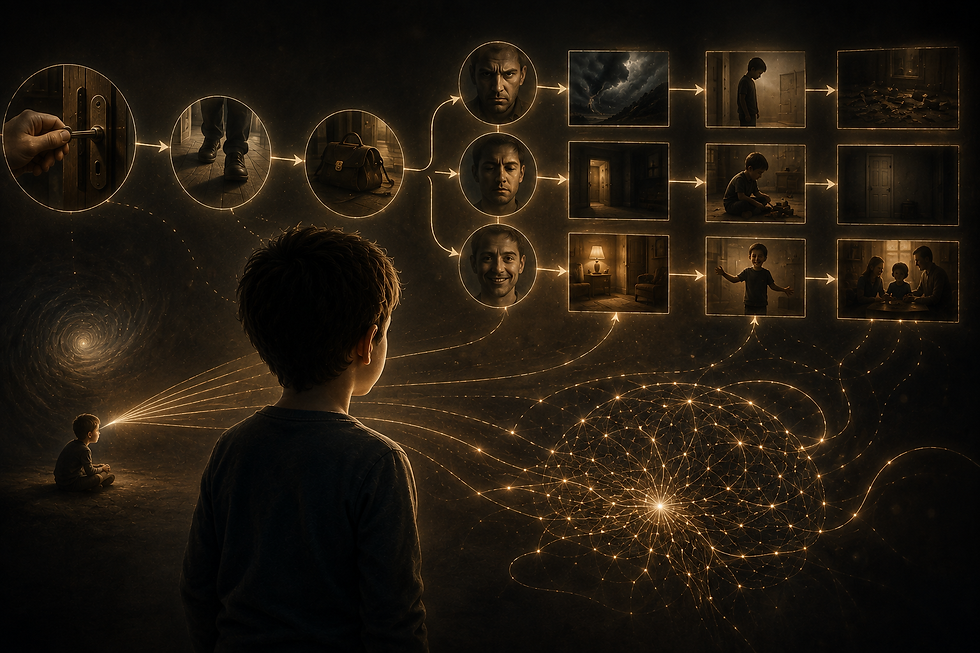
An unpredictable environment leaves only one strategy available: to watch.
All the time.
And what settles in then is not a fear of one particular thing; it is a permanent way of being present to the world.
A child, in such a context, does not simply learn a list of correspondences.
They do not only learn: « when he puts his keys down like that, the evening is going to be difficult ».
They learn a sequence. A syntax. A new grammar.
This signal announces that state. That state announces this consequence. And that consequence requires, from me, such and such an attitude.
They do not memorise isolated words. They learn to read sentences before they are spoken.
It is a learning of remarkable sophistication, and it happens almost entirely outside language. Long before the child can say what they perceive, they are already acting on what they have perceived.
And above all: it works.
And that is the point we almost always forget.
We speak of vigilance as a problem. But for the child who developed it, it was never a problem.
It was a solution.
Noticing before the others makes it possible to leave a room in time, not to ask the question at the wrong moment, to defuse things before they escalate, to become well-behaved, funny, useful, silent — according to what the situation requires.
Watching is rewarded. Regularly. Effectively.
And that is precisely what makes it so robust.
One does not easily unlearn a strategy that has worked.
Especially when it worked at a time when one had no other choice.
No one ever decided to become hypervigilant.
We are all looking for regularities

One of the fundamental functions of learning is regularity.
When every time you press a switch the light comes on, you soon no longer need to think about it: switch = light.
Your brain has learned the relationship.
Now let us imagine that the light comes on sometimes, but sometimes not. Sometimes five seconds later. Sometimes a harsh noise sounds instead.
Then, very quickly, you would probably pay far more attention to that switch — not because it is systematically dangerous, but because it has become hard to predict.
Even if a parent or an educator is not a switch, and a child is not a simple statistical system, the principle helps us understand something.
When the environment is predictable, we can gradually stop devoting attention to certain things.
When it is not, continuing to check becomes useful.
In 2003, Seth Pollak and Stephanie Tolley-Schell studied the attention of physically maltreated children faced with different emotional faces.
They found that their attention showed a particular pattern when an angry expression appeared.
When the angry face was relevant information, these children made greater use of it.
But when it became necessary to shift attention elsewhere, they also had more difficulty disengaging from it.
It is a fascinating observation, because it already contains both faces of hypervigilance.
On one side: spotting quickly what matters.
On the other: finding it harder to stop giving it importance.
In a genuinely hostile environment, this asymmetry can make sense.
If an adult's expression of anger sometimes announces a threat, missing it can cost far more than detecting it when it will finally lead to nothing.
The system may therefore learn something like:
« Better to notice too often than too late. »
This is obviously not a sentence the child says to themselves consciously.
It is a way of representing the adaptive logic of the mechanism.
As we have just seen, no child ever decided to become hypervigilant, nor ever chose to devote part of their attention to faces, silences, changes of voice, or to what might happen next.
They simply learned that, in their world, noticing could be useful.
And sometimes, noticing before the others could protect them.
So they carried on.
The rule outlives the context

Years have passed. The child has grown up. They have moved away. They have chosen their relationships, their work, their places.
Let us assume that the adult they have become lives in a peaceful environment, surrounded by people who do not shout, who give warning, who explain.
The context has changed a great deal since their childhood, and yet something in them has not been updated.
They still notice the slightest change of tone in a voice. Still wonder why that message went unanswered. Still sense immediately when the atmosphere of a room shifts. Still check, again, that everything is all right.
It is no longer useful, but it was never cancelled.
So the question is perhaps not: « Why do I watch so much? »
But: « What did watching allow me to do, when I needed it? »
Because before being a problem…
Hypervigilance may well have been a solution.
But then, why does an alarm go on sounding…
…long after the fire has gone out?


Comments