


Why am I always on my guard? - Episode 2

This alarm that never switches off

Years have passed, and the child who listened to the sounds of the house has become an adult. They have their own home, their own hours, their own habits. No one shouts any more. No one comes in slamming doors.
And yet, like every evening, this evening again, when the key turns in the lock, something in them will listen.
How long the key takes to turn, the sound of steps in the hallway, the way a bag is set down.
They do not even think about it - it is like a reflex - and within seconds, without having seen anything, they will already know what mood the person they love is coming home in.
We do not perceive the world, we predict it. Our nervous system does not simply wait, it anticipates; it constantly produces hypotheses about what is going to happen, and compares what arrives with what it expected.
This is what allows us to cross a street, to catch a falling object, to understand a sentence before it is finished.
We do not experience the world. We anticipate it, in advance, and we respond.
This completely changes the way we understand vigilance.
For if the brain is a prediction machine…
…then vigilance is not an over-sensitive sensor; it is a model of the world.
A model that was built in a particular context, with particular rules…
…and that goes on running long after that context has disappeared.
What resembles danger ends up becoming danger
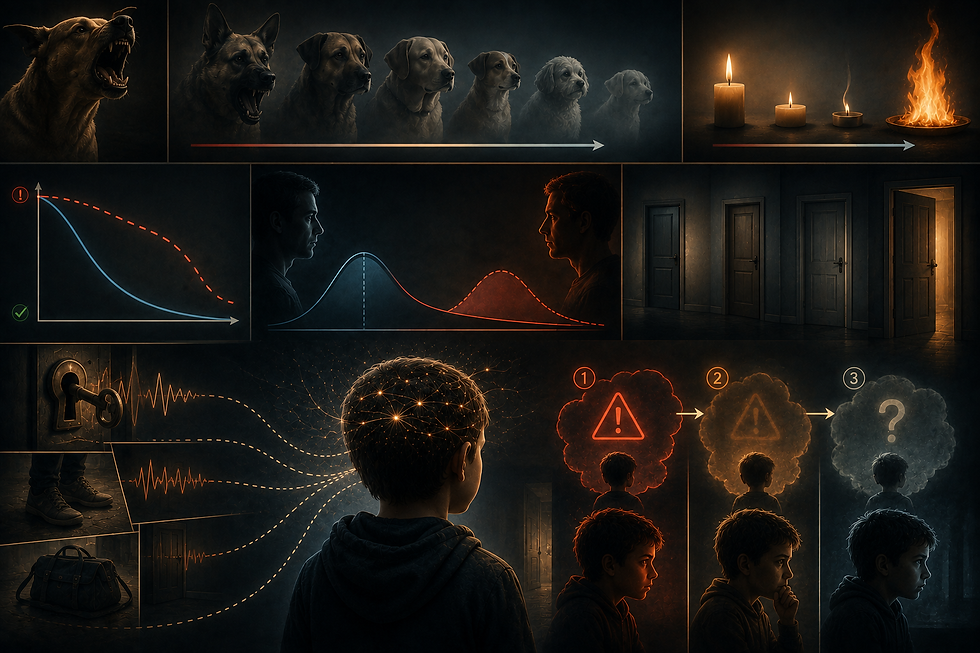
A system that predicts does not merely recognise what it has already encountered; it extends, it transfers what it has learned to whatever resembles it, however vaguely.
This is an absolutely necessary property. Without it, everything would have to be relearned each time: this dog bit, but what about that one? This flame burned, but the other?
We generalise, and so much the better.
But this extension has a geometry, and that geometry is not the same for everyone.
Shmuel Lissek and his team measured it precisely. The principle of their experiments is simple: a person learns that a particular signal announces something unpleasant. Then they are shown signals resembling the first less and less, and one observes at what point their reaction dies away.
In control participants, the response decreased more sharply as the stimuli moved away from the initial danger signal.
In the groups presenting with panic disorder or generalised anxiety, this decrease was more gradual: the response generalised to a wider range of stimuli.
In other words, it is not the alarm itself that differs.
It is the slope.
We have all learned to react to danger, and what distinguishes us is the speed at which we release that reaction when the situation resembles less and less what we once knew.
And this brings us straight back to the child of the first episode.
They did not only learn to react to the sound of a key in a lock; they learned to react to everything that resembles that sound.
A slightly sharper tone. An unusual delay before a reply. A silence that lasts a little too long. A door that closes a little too hard.
None of this is the original danger, but all of it resembles it closely enough.
And the slippage then happens in three steps, almost imperceptible:
« This is dangerous. »
« This resembles something dangerous. »
« I do not know exactly what this means, so I have to check. »
It is at the third step that something decisive has happened.
The trigger is no longer the threat.
It is the blur.
When uncertainty itself becomes a threat

Our nervous system constantly uses past experience, present information and their regularities to estimate what might happen next.
In a review published in 2021, the neuroscientists Ifat Levy and Daniela Schiller describe the threat response as a set of processes involving learning, memory and decision-making: we learn the cues that predict a threat, retain those associations, update them with experience, and use them to decide how to act.
And when a future threat is possible but uncertain, the problem becomes a particular one.
Dan Grupe and Jack Nitschke proposed in 2013 a model devoted precisely to this question in ‘Nature Reviews Neuroscience’.
Uncertainty about a potential threat makes it harder to avoid it, to prepare for it, or to reduce its consequences. It can then encourage anxious anticipation and alter attention, learning, the estimation of how likely the danger is, and readiness for action.
In other words, we do not only react to:
« Something is happening… »
But we are also equipped to react to:
« Something could happen… »
Staying permanently available to the possibility

Suppose you know that at five o'clock exactly a very unpleasant siren is going to sound for three seconds. You probably will not enjoy it, but you know when it will come, what will happen, and how long it will last.
You will be expecting a scheduled event which, when it occurs, will be taken in as “normal” and “harmless”. You will not be surprised, and you will even have time to prepare for it.
Now let us change one single variable.
The same siren will sound today, but you do not know when. Perhaps in five minutes, or in three hours, or at the very moment you have finally relaxed.
The threat is not necessarily stronger, but your relationship to it has just changed.
You must now remain available to its possibility.
This distinction between imminent danger and uncertain threat has long held an important place in experimental research on fear and anxiety.
Christian Grillon has notably proposed distinguishing phasic responses to a clearly identifiable danger from the more lasting states associated with an uncertain threat, which favour sustained apprehension and vigilance.
More recent neuroimaging work confirms that anticipating a threat whose timing is uncertain mobilises several brain systems involved in anticipation and preparation for threat, even if their exact organisation remains debated.
This brings us straight back to the child of the previous episode (Why am I always on my guard?).
The problem was perhaps not only
« Something bad is happening»,
But
« I do not know when, nor in what form, nor from which cue it might begin»
So one had to keep watching
Noticing is not yet being right

This is an essential distinction.
Someone may indeed notice: « Their tone has just changed. »
That observation may well be accurate.
But:
« He is angry with me » is already an interpretation.
And :
« Something is deteriorating between us » is a prediction.
Three levels have therefore followed one another very rapidly:
perception → interpretation → anticipation.
When we are hypervigilant, they can end up seeming to form only one:
« I can feel there is something. »
This is where a highly sensitive person and a hypervigilant person can sometimes look alike from the outside.
Both can notice a great many details.
The essential difference is not the quantity of information perceived.
It may lie in « the value assigned to it ».
Noticing a variation does not automatically mean one must protect oneself from it.
When it plays out between two people

In an adult life, the machinery of vigilance unfolds within relationships.
« Why has his tone changed? Why is she not answering? Why is this message so short? Why is this silence at the table? »
The question seems legitimate, but let us look at what it is really hiding.
It is not only a matter of understanding the other here, but of putting an end to an inner state that has become uncomfortable: not knowing.
And this is where a strange paradox appears: we watch in order to find the danger, but as soon as we believe we have found it, we stop really looking.
We ask « is everything all right? » without really listening to the answer to the end. We interpret a silence in a few seconds. We construct an explanation, and we settle into it.
This is not observation, but an attempt to close an open question as quickly as possible.
And that closing has a price, rarely visible at the time, because to stop the uncertainty, one has to act. So one acts.
One asks for confirmation. Then a second one. One rephrases the question differently, in case the first answer was merely polite. One rereads a message to check the tone. One sends one more word, just to see. One suggests something, softens things, apologises a little, sometimes without knowing what for.
Each of these gestures seems tiny.
But their function is not to understand the other. It is to obtain relief.
And that relief, when it comes, lasts remarkably little time.
There is something harder still: this movement, invisible from the inside, is sometimes very perceptible from the outside.
The person receiving these checks does not see worry; they see insistence, a question that keeps coming back, a sense of being scrutinised.
They may feel suspected, when the other was only seeking reassurance.
And it then happens that they close up a little, that they answer more briefly, that they avoid the subject, that they adopt a slightly more neutral tone so as not to feed something they do not understand.
Which produces exactly the signal that vigilance was waiting for.
This is perhaps the cruelest part of the mechanism.
It does not merely look for signs.
It sometimes manufactures them.
When not knowing becomes hard to bear

Psychology has a very useful concept for describing part of this phenomenon: « intolerance of uncertainty ».
The term can be misleading. It does not mean that a person would literally be incapable of living without certainty.
It refers rather to a tendency to regard uncertainty as particularly aversive, difficult or threatening, and to react to it negatively.
Nicholas Carleton, of the University of Regina, has devoted several important works to this notion. In 2016, in two syntheses published in the ‘Journal of Anxiety Disorders’, he proposes that the « fear of the unknown » constitutes a particularly fundamental element of many anxious phenomena — perhaps the one underlying many others.
He gives a remarkably precise definition of it: incapacity to endure the aversive response triggered by the perceived absence of sufficient information.
Not the fear of what is happening.
The fear of not knowing what is happening.
Intolerance of uncertainty had initially been studied mainly in generalised anxiety disorder. But research has gradually found it in many psychological difficulties. It is today generally regarded as a transdiagnostic factor: it does not belong to any one diagnosis.
And one point deserves to be emphasised, because it entirely changes how everything above should be read.
This intolerance of uncertainty is normally distributed in the general population.
It is not pathology. It is not a category into which some people fall and others do not.
It is a dimension.
We are all situated somewhere on that axis…
…and our position varies according to the areas of our life.
For some, it is: « I don't know. We'll see. »
For others, it is: « I don't know… and I need to know. »
That is why watching is not a character flaw.
It is a position on an axis we all occupy.
When the safety signal no longer convinces

There is an extreme situation in which this mechanism becomes particularly visible. It deserves to be looked at, provided we state at once that it is a limiting case.
The researchers Tanja Jovanovic and Seth Norrholm have studied how people suffering from post-traumatic stress disorder respond to danger signals and to safety signals.
The result is striking, but not in the way one imagines.
These people distinguished the two signals perfectly. Their perception worked very well. They saw perfectly clearly that the safety signal was present.
But their fear response did not diminish for all that.
The signal was perceived. It simply was not convincing.
So it is not a problem of detection. It is a problem of credit.
Let us state it immediately, because it matters: this result appears specific to post-traumatic stress disorder. It is not observed in people who are depressed without PTSD. It does not describe everyone, and certainly not ordinary vigilance.
But it may shed light on something more general.
And what if, to infinitely lesser degrees…
…a part of our everyday vigilance worked in the same way?
Not because we cannot see that everything is fine.
But because the fact that everything is fine does not entirely convince us.
Hypervigilance, a combination of four elements

What follows is not a research result, but a grid that I am proposing, a way of articulating what we have just seen.
It seems to me that a vigilance that has become permanent often combines four elements.
A low threshold of suspicion. It takes very little for the alarm to go off. A tone, a delay, a word.
A wide generalisation. Anything vaguely resembling the old danger is enough to activate the reaction.
A slow recovery. Once triggered, the alarm takes a long time to switch off — sometimes hours after the situation has become clear.
A high need for proof of safety. And these are proofs that almost always turn out to be insufficient.
These four elements do not work separately. They feed one another.
A low threshold produces more alerts.
A wide generalisation produces still more.
A slow recovery means the previous one is not over when the next arrives.
And the need for proof restarts the cycle, since no proof is ever quite enough.
So the opening question perhaps finds the beginning of an answer.
If the alarm goes on sounding in a house where there is no longer any fire, it is perhaps not because it still believes in the fire.
It is perhaps that it is waiting for proof that there will never be one again.
And that proof, no one can give it.
There remains, then, one final question:
If we cannot obtain that proof…
…can we learn to do without it?


Comments