


Why do others affect us so much? - Episode 2
- Jean-Dominique POUPEL

- 1 day ago
- 10 min read
The words we confuse: sympathy, empathy, compassion

Someone you love has just given you bad news.
A separation, the loss of a job, an illness, or simply this sentence: « I can't take it any more. »
At that moment, something happens in you; you may feel sadness, an impulse towards them, or a form of unease. A tension appears in your chest.
You immediately look for what to say, and you want to reassure, to advise, to put things in perspective, to take the person in your arms or to find a solution.
« I am so sorry for you. »
« I know exactly how you feel. »
« Don't worry, it will be all right. »
So many answers that seem close to one another, and yet do not always come from the same place.
In everyday life, we often use the words « sympathy », « empathy » and « compassion » as if they named one and the same capacity: being sensitive to what someone is going through.
But being touched by a person's suffering is not necessarily to understand it.
Understanding what they are going through does not necessarily mean feeling what they feel.
And feeling part of their pain does not yet mean that we know how to stay present with them.
These words do not merely name different intensities of one same emotion.
They describe different ways of entering into relation with another person.
Emotional contagion: when the other's state becomes our own

Let us come back to that person who says to you: « I can't take it any more. »
You feel their state, their nervousness, their exhaustion. Then your own breathing quickens. You begin to consider every possible consequence for daily life and the near future. You ask them rapid questions. You try to understand. You look for a solution. You insist that they react, that they do something immediately. And a few minutes later, you are probably more worried than they are.
What has happened?
You may have believed you were being deeply empathic. But above all, you were drawn into their state.
The psychologists Elaine Hatfield, John Cacioppo and Richard Rapson gave this phenomenon a name: « emotional contagion ».
An emotional state passes from one person to another, often through very rapid channels — facial expression, tone of voice, the rhythm of the body — and often without anyone noticing.
This is not empathy.
In contagion, the boundary between self and other becomes blurred. We do not necessarily understand the emotion: we reproduce it. We are carried along.
For example, a baby starts to cry on hearing another baby cry. Or a tense person walks into a room and, gradually, the whole group becomes more on edge. In a couple, one partner's agitation increases the other's, who in turn sends back still more agitation.
No one quite knows any more who started it. Everyone is now taking part in the same state.
Contagion is a primitive, automatic form of emotional sharing. Unlike a differentiated empathy, it does not necessarily require that we know the emotion comes from the other person in the first place.
This is why being an « emotional sponge » is not necessarily proof of a particularly developed empathy.
It may also indicate a difficulty in maintaining an inner boundary.
I feel the other…
…but I no longer know that I am feeling them.
Sympathy: feeling something for the other

Let us begin with the most familiar word: sympathy.
The Académie française notes that sympathy comes from the Greek « sumpatheia »: « sharing in another's suffering ». Composed of « sun », with », and of pathos », « what one experiences ».
In everyday language, having sympathy for someone generally means that we like them. That person seems agreeable to us. We feel affection, closeness, or a favourable disposition towards them.
But the word can also take on another sense when someone is going through an ordeal.
We then feel sorrow “for” that person. We are touched by what is happening to them.
For example, when a friend tells us that they have just lost their job, we answer: « I am so sorry. That must be very hard. »
This reaction can be sincere, warm and well-meaning, and yet we remain, in a certain way, outside their experience.
We see their suffering from our own position.
We may even be tempted to imagine what “we” would feel in their place: « If I lost my job, I would be completely devastated. »
The sentence seems to speak of the other, but it speaks mainly of us.
Sympathy brings us closer.
It shows sensitivity, affection, sometimes genuine solicitude.
It does not, however, guarantee that we understand precisely what the person is living through.
We can feel a great deal of sympathy for someone…
…and be completely mistaken about what they need.
Empathy: entering the other's world without claiming to become them
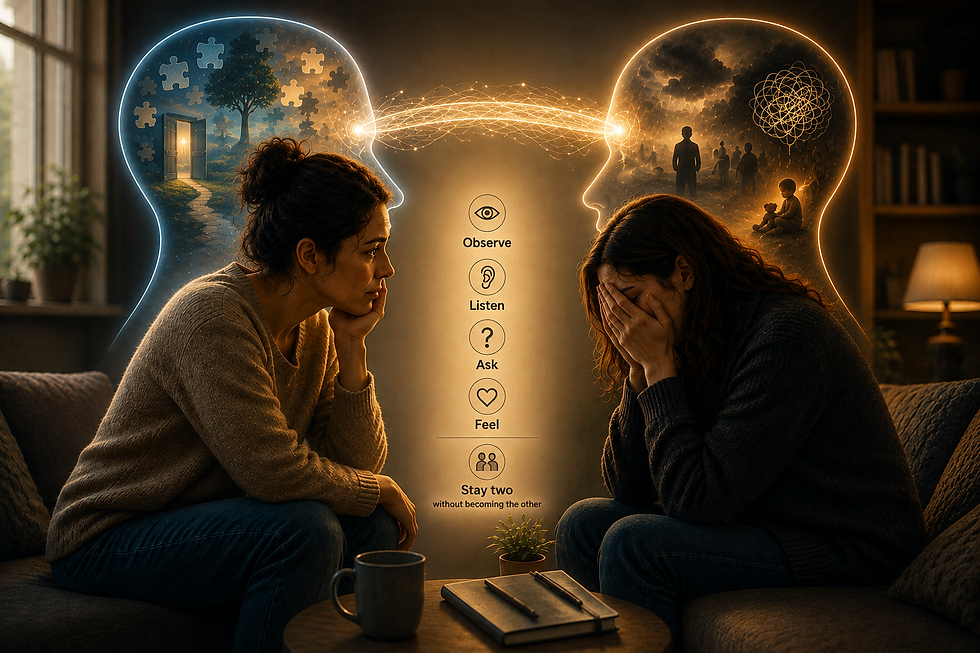
Empathy calls for a different positioning. It is no longer only a matter of being sad for someone. It is a matter of trying to understand their experience from their own point of view.
Not: « What would I feel if this happened to me? », but rather: « What might this situation mean for this person, with their history, their needs, their fears and their way of seeing the world? »
This nuance is fundamental, because putting oneself in the other's place is, strictly speaking, impossible.
We can never truly become them.
We do not have their body, we have not lived their childhood, we do not carry their memories, their attachments, their wounds, nor their map of the world.
We can only draw closer to their experience.
Listen to it. Observe it. Question it. And accept that a part of it escapes us.
The review by Benjamin M. P. Cuff and his colleagues, published in 2016 in Emotion Review, which examined some forty definitions of empathy, identified three elements and one condition that recur in most contemporary conceptions: understanding, feeling and sharing something of another's world, while maintaining a distinction between self and other.
This last part is essential.
Empathy does not consist in becoming the other.
It consists in drawing close to them without forgetting that we are two.
Understanding or feeling: the two faces of empathy

Two broad dimensions of empathy are generally distinguished.
Cognitive empathy
This is the capacity to understand a person's point of view, their thoughts, or their likely emotions.
A colleague is behaving unusually coldly.
We might conclude: « He looks down on me. »
But we can also ask ourselves: « Is he worried? Tired? Preoccupied by something that has nothing to do with me? »
We do not necessarily feel their emotion. We are trying to understand its logic.
This capacity is precious.
It allows us to step back, to consider several interpretations, and not to reduce someone's behaviour straight away to what it provokes in us.
But it also has an important limit.
Understanding a person intellectually does not necessarily mean caring about them.
It is possible to understand someone's fears, expectations and vulnerabilities very finely, and to use that understanding in order to help them.
But also in order to manipulate them.
Cognitive empathy is not, on its own, a guarantee of goodwill.
Affective empathy
Affective empathy refers to the emotional resonance that occurs when someone's state finds an echo in us.
A person cries and we feel our throat tighten. They describe their fear and a tension appears in our stomach. We see someone bang into something hard and our own face contracts.
We do not live their experience exactly, but something of their state is momentarily reflected in us.
The work of Tania Singer and her team, published in 2004, showed that empathy for pain or distress involves in particular regions that also take part in our own affective experience, without this meaning that we literally and entirely feel the other's pain.
Empathic responses also depend on the context, on our history, on our relationship with the person, and on the way we interpret the situation.
Here we return to the subject of the first episode: our system does not remain entirely outside what it observes. It resonates.
But this resonance is neither a perfect reading nor a magical transmission.
Feeling a tension while watching someone suffer…
…does not mean that we know exactly what they are experiencing.
Our own history always takes part in what we feel.
The trap of « I know exactly how you feel »

This sentence often comes from a good intention: « I know exactly how you feel. »
It is trying to say: « You are not alone ». But it can produce the opposite effect.
Because it closes the space at the very moment when we believe we are opening it.
How could we know « exactly » what another person is living through?
People can lose their job on the same day and go through radically different experiences.
For one, it is a financial catastrophe; for another, a humiliation. For a third, it will be a relief they do not yet dare acknowledge; and for a fourth, the brutal disappearance of an identity around which their whole life had been built.
The event looks the same. The experience does not.
Saying « I understand exactly » can then replace the discovery of the other by the memory of ourselves.
We stop listening to them. We open our own inner file.
Then we tell them our story, believing we have entered theirs.
A truly empathic response would perhaps be less spectacular: « I don't know exactly what this means for you. But I am here, and I would like to understand. »
This sentence does not claim to abolish the distance.
It acknowledges it.
And it is precisely this acknowledged distance that sometimes allows a genuine encounter.
When empathy becomes personal distress

When we are faced with someone's suffering, our own discomfort can become so intense that our attention gradually leaves the other person.
Outwardly we still want to help them, but inwardly we are above all seeking to stop what their pain provokes in us.
This is what can happen when we say too quickly:
« Don't cry. »
« You have to be strong. »
« Try to think about something else. »
« You'll see, everything happens for a reason. »
These sentences are not always cruel, and can even be spoken with a great deal of affection.
But they sometimes serve less to welcome the person than to interrupt our own unease.
We cannot bear their tears, we do not know what to do with their despair, we are confronted with our own powerlessness.
So we try to make their emotion disappear in order to recover a little stability ourselves.
Tania Singer and Olga Klimecki, in 2014, draw a precise distinction between « empathic distress » (submersion, negative emotions, withdrawal) and compassion (a sustainable state, oriented towards the other).
The other's suffering produces anxiety, stress or a sense of invasion in us. When this activation becomes too strong, it can encourage withdrawal, avoidance, or reactions centred more on ourselves than on the person who is suffering.
This is also what exhausts those whose work or life consists in accompanying others. People often speak of « compassion fatigue », as if too much compassion ended up wearing us down.
The work of Singer and Klimecki suggests rather the opposite: it is not compassion that exhausts, it is distress. Remaining submerged in the other's suffering, without this opening onto anything else, costs infinitely more than staying present with them.
The question is no longer: « What do they need? »
It becomes, silently: « What can I do to stop feeling this? »
Compassion: being touched without being carried away

Compassion too begins with the recognition of suffering.
But it adds something:
An orientation.
An intention.
A movement towards care.
Compassion could be summed up like this: « I acknowledge your suffering, I stay present, and I wish to help ease it. »
It does not necessarily consist in feeling the same emotion as the other, nor does it seek to remove immediately what they are going through.
It sometimes makes it possible to stay there, without fleeing, without invading, without turning the person into a problem to be solved.
The same work by Singer and Klimecki describes compassion as a warm response of concern and care in the face of suffering, accompanied by a motivation to help or to relieve it. It is therefore distinguished from simple empathic resonance by this orientation towards action and support — and this action is not always spectacular.
Sometimes, compassion offers concrete help.
Sometimes, it protects.
Sometimes, it confronts.
Sometimes, it sets a limit.
And sometimes, it simply sits beside someone…
…who does not need an immediate solution…
Compassion is not always gentle

We readily associate compassion with a calm voice, a tender gesture or a reassuring word.
But a compassionate response is not necessarily pleasant at the time.
Saying to someone: « I love you, but I can no longer keep lying to protect you from the consequences of your actions » can be profoundly compassionate.
Refusing to give money to a person when this directly sustains an addiction can also be a form of compassion.
Reporting dangerous behaviour, setting a limit or leaving a destructive relationship are not necessarily failures of empathy.
Compassion does not seek only to remove immediate discomfort; it tries to respond to what genuinely protects the life, the dignity and the integrity of each person.
A gentleness that sustains destruction is not always kind.
And a limit that interrupts a destructive mechanism is not necessarily cruel.
Feeling with the other without disappearing

Sympathy makes us sensitive to what is happening to someone.
Empathy allows us to draw closer to their world.
Emotional contagion sometimes carries us into their state.
Personal distress “recentres” their suffering on our own discomfort.
And compassion turns sensitivity and understanding into a presence oriented towards care.
But in real life, these experiences do not present themselves in perfectly separate boxes.
They mix. They follow one another. They change according to the people, the situations, and our own inner state.
We may begin by being infected by someone's anguish, then recover a distinction between them and us, gradually understand their experience, and finally respond to them with compassion.
The point, then, is not to become perfectly empathic.
It is to become conscious enough to recognise what is happening in us on contact with the other.
Because feeling everything that others feel does not necessarily make us more loving.
Sometimes it simply leaves us more invaded - and understanding someone does not consist in abolishing the distance between us.
It consists in making that distance a space of encounter.
So, the next time someone suffers in front of you, perhaps the question will no longer only be:
« What can I say to them? »
But:
« Am I feeling for them, with them… or in their place? »
And above all:
« Can I stay close enough to meet them…
…without losing myself in them? »


Comments